Αναρτήσεις

Εμφάνιση αναρτήσεων με την ετικέτα figurines

Translate

Bull of Dionysios of Kollytos (Kerameikos)

Εικόνα
ΕΛΛΗΝΙΚΑ Bull from the grave enclosure of Dionysios of Kollytos, near the Way of the Tombs (345-350 BC) The bull stood on a high pedestal in the middle of the grave enclosure, behind a naiskos on which were cared epigrams and the name and patronymic of the deceased, Dionysios son of Alphinos. Dionysios, who died unmarried, lived in the deme of Kollytos, near the Kerameikos, and on the island of Samos, where he served as trasurer of the Heraion for the year 346/5 BC. Kerameikos, Ancient Graveyard, Athens, Greece. Collytus or Kollytos (Ancient Greek: Κολλυτός) was a deme of ancient Attica, located in the city of Athens. It was located within the walls of Themistocles, south of the Areopagus and southwest of Acropolis. It was famed due to its association with Plato, whose family was from this deme. Αγόρι κάθεται μπροστά από τον τάφο του Διονυσίου του Κολλυτού (τέλη 4ου αιώνα π.Χ.) στην Οδό των Τάφων στο αρχαίο ελληνικό Κοιμητήριο του Κεραμεικού, Αθήνα, φωτογραφία του Γερμανού φωτογράφου W...

Η Κυρά της Φυλακωπής / The Lady of Phylakopi

Εικόνα
Ελληνική ιστορία  /  Αρχαία Ελλάδα  -  Τεχνουργήματα  / Αγάλματα / Statues -    Τελευταίες Αναρτήσεις Η "Κυρά της Φυλακωπής", πήλινο γραπτό γυναικείο ειδώλιο θεάς ή ιέρειας, από το μυκηναϊκό "ιερό" της Φυλακωπής έναν από τους σημαντικότερους προϊστορικούς οικισμούς στο Αιγαίο. 14ος αιώνας π.Χ. Θεωρείται ότι αναπαριστά τη Μητέρα Θεά, σύμφωνα με τη μυκηναϊκή θρησκεία. Αρχαιολογικό Μουσείο της Μήλου The Lady of Phylakopi. Wheel-made female figurine of a goddess or priestess from West Shrine in Phylakopi. Height 45 cm. Late Helladic III A period, Phylakopi III, probably 14th century BC. Archaeological Museum of Milos, Cat. no. B 655. Discovered by Colin Renfrew, Excavations 1974-77.

Head of Isis, after 138 AD / Κεφάλι της Ίσιδας, μετά το 138 μ. Χ..

Εικόνα
Ελληνική ιστορία  /  Αρχαία Ελλάδα  -  Τεχνουργήματα  / Αγάλματα / Statues -    Τελευταίες Αναρτήσεις Head from a cult statue of Isis, after 138 AD. Archaeological Museum of Thessaloniki.Greece Κεφάλι από λατρευτικό άγαλμα της Ίσιδας, μετά το 138 μ. Χ.. Αρχαιολογικό Μουσείο Θεσσαλονίκης, Ελλάδα. Τα μαλλιά ήταν χρωματισμένα και πιθανόν επιχρυσωμένα. Από το μεγάλο ιερό των Αιγυπτίων θεών της αρχαίας Θεσσαλονίκης, Ελλάδα The hair was colored and possibly gold-plated. From the great sanctuary of the Egyptian gods of ancient Thessaloniki, Greece

Head of Isis, 3rd c. BC / Κεφάλι της Ίσιδας, 3ου αιώνα π.Χ

Εικόνα
Ελληνική ιστορία  /  Αρχαία Ελλάδα  -  Τεχνουργήματα  / Αγάλματα / Statues -    Τελευταίες Αναρτήσεις Κεφάλι της Ίσιδας, Αρχαιολογικό Μουσείο Θεσσαλονίκης, Ελλάδα. Αρχές 3ου αιώνα π.Χ Head of Isis, Archaeological Museum, Thessaloniki, Greece. Early 3rd century BC Από το μεγάλο ιερό των Αιγυπτίων θεών της αρχαίας Θεσσαλονίκης, Ελλάδα From the great sanctuary of the Egyptian gods of ancient Thessaloniki, Greece

Inscribed base of a statue of Thessaloniki 2nd c. B.C. / Ενεπίγραφη βάση αγάλματος Θεσσαλονίκης, 2ος αι. π.Χ.

Εικόνα
Ελληνική ιστορία  /  Αρχαία Ελλάδα  -  Τεχνουργήματα  / Αγάλματα / Statues -    Τελευταίες Αναρτήσεις Inscription reading "To Queen Thessalonike, (Daughter) of Philip", Archaeological Museum of Thessaloniki Επιγραφή «Στη Βασίλισσα Θεσσαλονίκη, (Κόρη) του Φιλίππου», Αρχαιολογικό Μουσείο Θεσσαλονίκης Ενεπίγραφη βάση αγάλματος Θεσσαλονίκης, του 2ου αι. π.Χ., που βρέθηκε στην περιοχή της αρχαίας Αγοράς και μέρος μιας ομάδας αγαλμάτων της οικογένειας του Μεγάλου Αλεξάνδρου. Επιγραφή: ΘΕΣΣΑΛΟΝΙΚΗΝ ΦΙΛΙΠΠΟΥ ΒΑΣΙΛΙΣΣΑΝ Inscribed base of a statue of Thessaloniki, of the 2nd c. B.C., found in the area of the ancient Agora and part of a group of statues of the family of Alexander the Great. Inscription: ΘΕΣΣΑΛΟΝΙΚΗΝ ΦΙΛΙΠΠΟΥ ΒΑΣΙΛΙΣΣΑΝ Thessaloniki is a Greek city.  The city was founded in 315 BC by Cassander of Macedon, who named it after his wife Thessalonike, daughter of Philip II of Macedon and sister of Alexander the Great. 

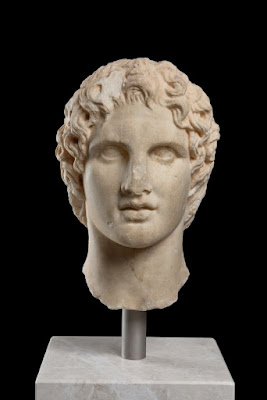
Head of a statue of Alexander the Great, 2-3 cent. BC

Εικόνα
ΕΛΛΗΝΙΚΑ © Μουσείο Ακρόπολης Head of a statue of Alexander the Great Location Archaiological Museum of Acropolis, Athens, Greece Artist Leochares Classical Period Date After 338 BC Dimensions Height: 0.35 m Length: 0.23 m Width: 0.245 m Material Marble from Penteli Description It was found in 1886 near the Erechtheion on the Acropolis. Alexander the Great is portrayed at a young age, as he would have been during his sole visit to Athens, after the battle of Chaironeia in 338 BC. The deep set eyes, the upward glance, the half-open lips as well as the characteristic hairstyle, with rich curls standing up over the forehead, the anastoli, are all typical features of Alexander. Red paint surviving in some areas of the hair was most probably the base-coat for the curls's final, golden hue; whereas the way the locks are formed at the back of the head suggests that the head was adorned either by a wreath or a band rendered in some other material that has not survived. The statue is conside...

New York Kouros

Εικόνα
ΕΛΛΗΝΙΚΑ The New York Kouros is one of the artifacts that officials determined had been stolen from archaeological sites. It is also one of the earliest marble statues of a human figure carved in Attica. The rigid stance, with the left leg forward and arms at the side, was derived from Egyptian art. The pose provided a clear, simple formula that was used by Greek sculptors throughout the sixth century B.C. In this early figure, almost abstract, geometric forms predominate; and anatomical details are rendered in beautiful analogous patterns. The statue marked the grave of a young Athenian aristocrat. Style The statue is similar to the (near-contemporary) statue of Mentuemhet and represents an example of daedalic statuary style. The statue is stylized and not representational. It is highly geometric, and the body is idealized and abstracted, especially in the muscles and the areas of the joints. The eyes and face are not realistic to how a person would look; this statue is not attempting...

The Terrace of the Lions, Delos, Greece

Εικόνα
ΕΛΛΗΝΙΚΑ The island of Delos, recognized as the birthplace of the god Apollo, has been a sacred area used for various reasons throughout history. Today it is one of the most important archaeological sights in Greece and is covered in excavations, one of which is the famous Terrace of the Lions. This terrace was erected and dedicated to Apollo by the people of Naxos just before 600 BCE. The terrace consisted of a row of nine to twelve marble carved lions that faced eastward towards the Sacred Lake of Delos along the Sacred Way from Skardana Bay to the temples.  The lions, with their mouths open as if roaring or snarling, were both meant to guard the sanctuaries and to inspire a feeling of divine fear among the worshippers. The way in which they were positioned is similar to the way sphinxes were set up along avenues in ancient Egypt. Today, only five of the original lions remain with remnants of three others and the headless body of another has been transported and put over the main...