
Αναρτήσεις

Εμφάνιση αναρτήσεων με την ετικέτα Revolution

Translate

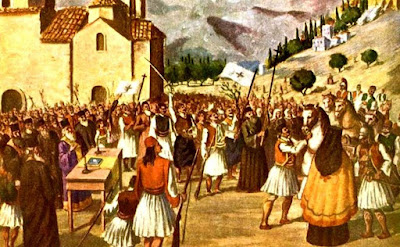
Celebration of the Greek Revolution of 1821

Εικόνα
ΕΛΛΗΙΚΑ It is one of the most important days of the year for the Greek Nation: March 25th! It is the National Holiday commemorating the Greek Revolution and the starting point of the reconstitution of the New Greek State. But why March 25 and not 23 of the same month or some other date? The anniversary of celebrating the uprising of 1821 on March 25 was established on March 15, 1838 by King Otto. The purpose was to connect the feast of the Annunciation of the Virgin with the Revolution. It was also the desire (as it is said) of Alexandros Ypsilantis and the Philiki Etairia to do something like this, so as to "stimulate the morale of the enslaved Greeks". Flag decoration for March 25 in Santorini The Phanariot poet Panagiotis Tsoutsos proposed in 1834 the establishment of a celebration of the Greek Revolution on March 25, stating that it was the day of the generalization of the revolution in the Peloponnese and the rebirth of Greece, in a memorandum which Prime Minister Ioanni...

Theodoros Kolokotronis ( Geros tou Moria / The "Old Man of Morea")

Εικόνα
ΕΛΛΗΝΙΚΑ Theodoros Kolokotronis is the pioneer and the most emblematic figure of the Struggle. His father was Constantis Kolokotronis, from Limbovisi, Arcadia, and his mother, Zambia Kotsaki, from Alonistaina, he himself was born in Ramovouni, Messinia. The equipment, weapons and personal belongings of Theodoros Kolokotronis. Fourteen-year-old left his village to sell wood in the enslaved Tripolitsa and when he was beaten by a Turk, he vowed that he would return one day and free her, and he succeeded on September 23, 1821. Η υπογραφή του Θεόδωρου Κολοκοτρώνη (1770-1843), Έλληνα στρατηγού και ηγέτη της Επανάστασης του 1821. Από επιστολή του με ημερομηνία 26 Μαΐου 1827. In the year 1818 he was initiated into the Friendly Society in Zakynthos, where he was serving in the English army. His name was associated with the most important battles fought in the Peloponnese. Dervenakia, Valtetsi, Karytaina, Trikorfa, Palamidi, Grana, Patras and other places speak of his bravery, his strategic thin...

Liberation of Kalamata, March 23 1821

Εικόνα
ΕΛΛΗΝΙΚΑ From the beginning of March 1821, there was an uproar of war in Mani. The actions of Papaflessas, Anagnostaras and the arrival of Theodoros Kolokotronis in Kardamili contributed to this. Kolokotronis on horseback with an army escort. Under Nikolaos Varveris. Koutlidis Collection In mid-March, a ship loaded with munitions, sent by the Friends of Smyrna, arrives at the port of Almyros, outside Kalamata. Nikitaras and Anagnostaras undertook to carry the cargo, which was accompanied by armed men. "The "prankster" of souls Papaflessas stirs up the enslaved Greeks" Painting by Vangelis Drakos, 1971. The fact is reported to the Ottoman authorities of Kalamata, who are however informed that it is oil and that the cargo is being guarded because there are robbers in the area. Papaflessas and his associates were simultaneously spreading rumors about the existence of dangerous bandits in the area. The then governor of Kalamata, Suleiman Agas Arnautoglu, summoned the ci...

Russia's Huge Offer to the Greek Revolution of 1821

Εικόνα
ΕΛΛΗΝΙΚΑ Russia's Huge Offer to the Greek Revolution of 1821 Russia's Offer to the Greek Revolution of 1821. A decisive contribution that Western historiography, diplomacy and politics tried to erase from the first years of the life of the modern Greek state. Which state was forcefully led to orient itself to the West (Kapodistria murder, Bavarian dictatorship, persecution of Russophile fighters and trial of Kolokotronis). a) The Friendly Society was founded in 1814 in Odessa, i.e. in a Russian city and not in Paris or some western city. Today, the Museum of Friendship still exists there. The Friends initially propagated that the Invisible Authority of their organization was the Tsar himself. Then they made a proposal to Kapodistrias who was the Tsar's foreign minister (since 1815) and when he refused they offered the leadership of Filiki to Alexander Ypsilantis who was an officer in the Russian army, a supporter of the Tsar himself and who enthusiastically accepted to lead...